Browser-in-the-Browser Phishing: When Fake Login Windows Look Real
Not every phishing page looks like a basic fake website.
Some attacks now copy the browser experience itself.
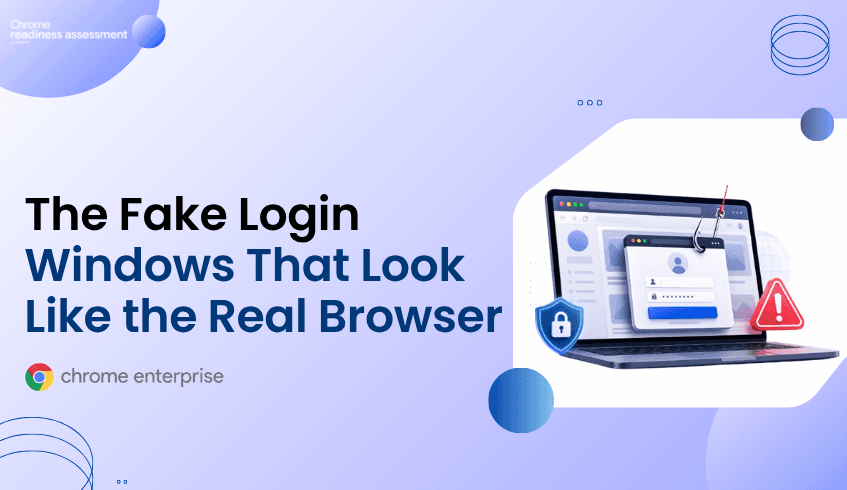
This technique is known as Browser-in-the-Browser phishing. Instead of sending users to a simple fake login page, attackers create a realistic login window inside the webpage. It can look like a Google, Microsoft, Facebook, or Apple sign-in popup, complete with familiar design elements and a fake address bar.
To the user, it may look like a normal authentication window.
But it is still part of the malicious webpage.
That is what makes the attack dangerous. The user may believe they are signing into a trusted service, while their credentials are being captured by the attacker.
Browser Insights in Chrome Readiness Assessment helps teams review the browser activity around suspicious destinations, affected devices, browser versions, usage patterns, and device-level details. CEP Accelerator helps prioritize which findings need attention, while Chrome Enterprise Premium helps reduce browser-layer exposure with URL filtering, threat protection, context-aware access, browser policy enforcement, and data protection.
Why this attack is hard to spot
Users are trained to recognize login windows.
They know what a sign-in popup looks like. They expect to see a familiar brand, a username field, a password field, and a clean interface.
Browser-in-the-Browser phishing abuses that trust.
The fake login window appears inside the page, but it is designed to look like a real browser popup. The attacker controls the entire design, including the fake address bar, icons, buttons, and window layout.
This can trick users because the page does not always feel suspicious. It may appear after clicking “Sign in with Google,” “Continue with Microsoft,” or another familiar authentication option.
The danger is that the user is not only trusting a website.
They are trusting what looks like the browser itself.
Why this becomes an enterprise risk
In enterprise environments, employees use browser-based sign-ins constantly.
They sign into email, SaaS tools, cloud storage, customer platforms, HR systems, finance dashboards, developer portals, and AI tools. Many of these services use familiar SSO flows.
That makes fake login windows more convincing.
A user may think they are completing a normal sign-in step to access a document, portal, message, or shared file. If the page is malicious, the attacker may collect credentials or guide the user into a fake authentication flow.
This risk becomes more serious when the affected device also accesses sensitive business applications.
A fake login attempt is not just a user mistake. It is a browser-layer exposure that can sit close to company data, cloud apps, and business workflows.
Where Browser Insights Adds Value
For Browser-in-the-Browser phishing, Browser Insights helps teams review the browser activity around suspicious or risky destinations.
It can show which devices accessed questionable web locations, which browsers and versions were involved, and whether those devices also show other browser-level risks.
This gives IT and security teams a clearer starting point to investigate affected devices, user groups, and suspicious destinations instead of treating the issue as a single isolated phishing click.
Browser Insights can also help teams understand whether certain devices or groups are repeatedly visiting risky or unsecured domains that may be used for fake login flows.
That visibility matters because phishing does not only happen in email. The browser is where the fake login experience appears, where the user interacts with it, and where sensitive access may be exposed.
Strengthening Browser Protection with Chrome Enterprise Premium
CEP Accelerator helps prioritize the browser risks surfaced through Browser Insights and connects them to relevant Chrome Enterprise Premium capabilities.
For Browser-in-the-Browser phishing, this means focusing on devices, users, or groups that are reaching suspicious login-style pages, risky domains, or browser environments that already show other risk indicators.
Chrome Enterprise Premium helps reduce exposure through URL filtering, threat protection, browser policy enforcement, context-aware access, and data protection controls.
This allows organizations to apply stronger protection around suspicious web destinations, sensitive SaaS access, and browser-based workflows where users may be exposed to fake login experiences.
Why Business Leaders Should Care
Browser-in-the-Browser phishing matters because it targets trust.
Employees may not realize the login window is fake because it looks like a normal browser authentication flow. If attackers capture credentials or trick users into a fake login process, business data and SaaS access may be at risk.
The browser is now where users sign into most business systems.
That means phishing protection must also operate at the browser layer.
Browser Insights helps teams understand where suspicious browser activity is happening. CEP Accelerator helps prioritize what needs attention first. Chrome Enterprise Premium helps strengthen protection where users interact with business apps and login flows.
FAQ
What is Browser-in-the-Browser phishing?
Browser-in-the-Browser phishing is a technique where attackers create a fake browser-style login window inside a webpage to trick users into entering credentials.
Why is it difficult for users to recognize?
The fake window can copy familiar login designs, buttons, icons, and address-bar styling, making it look like a real authentication popup.
Why does this matter for enterprises?
Employees use browser-based login flows every day for SaaS tools, email, cloud storage, internal systems, and business platforms. A convincing fake login window can put those accounts and workflows at risk.
How does Browser Insights help?
Browser Insights helps teams review suspicious browser activity, risky or unsecured destinations, affected devices, browser versions, usage patterns, and device-level details.
How does Chrome Enterprise Premium help?
Chrome Enterprise Premium helps strengthen browser-layer protection with URL filtering, threat protection, context-aware access, browser policy enforcement, and data protection controls.
Browser-in-the-Browser phishing shows how attackers can make a fake login window look like part of the browser itself. Use Browser Insights in Chrome Readiness Assessment to review suspicious browser activity and affected devices, then use CEP Accelerator to prioritize Chrome Enterprise Premium protections that help reduce browser-layer exposure.


