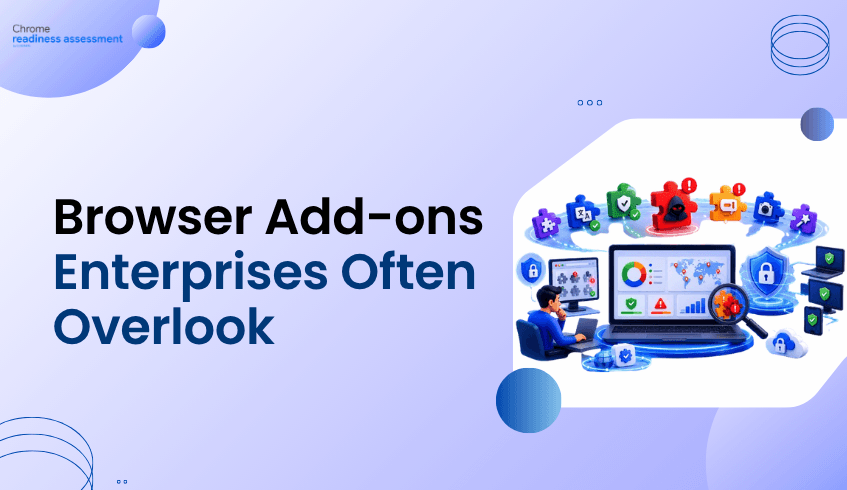
Unverified Extensions: The Browser Add-ons Enterprises Often Overlook
Browser extensions are small tools that help users work faster. They can block ads, manage passwords, capture screenshots, translate content, improve productivity, or connect users to business applications.
But in an enterprise environment, extensions can also become a security blind spot.
The risk is not only about what an extension does. The bigger issue is whether the organization knows which extensions are installed, which ones are trusted, and which devices are using unverified or unmanaged add-ons.
Browser Insights helps teams identify extension exposure across the fleet. CEP Accelerator helps teams understand which risks should be prioritized, while Chrome Enterprise Premium helps strengthen browser management and security controls.
Why unverified extensions create risk
Employees often install browser extensions because they are convenient. An extension may look simple, useful, and harmless. But once installed, it becomes part of the same browser environment where users access business applications, customer information, internal dashboards, cloud storage, and sensitive workflows.
Chrome extension safety guidance explains that Chrome can warn users about extensions suspected of malware, policy violations, unpublished extensions, extensions installed outside the Chrome Web Store, and extensions that have not clearly published their data practices.
This matters for enterprises because an extension does not need to look dangerous to create risk. It may be outdated, unsupported, unreviewed, installed from an unknown source, or simply invisible to the security team.
The issue is simple:
If the organization cannot see the extensions running across its browsers, it cannot properly evaluate or manage the risk.
Why extension visibility matters
Many organizations closely monitor devices, operating systems, antivirus tools, and installed software. Browser extensions often receive less attention.
This leaves security teams with important unanswered questions:
Which extensions are installed across the organization?
Which devices contain unverified extensions?
Are the same extensions appearing across multiple teams?
Are users installing tools that have not been approved?
Without fleet-wide visibility, extension risk becomes difficult to understand and control.
The Chrome Web Store program policies also demonstrate why extension trust should not be assumed. Extensions that create security threats, access information beyond what is necessary, mislead users, or abuse the platform may violate store policies and be removed.
For enterprises, this reinforces an important point: being installed in a browser does not automatically mean an extension is appropriate for business use.
How Browser Insights helps
Browser Insights gives IT and security teams a clearer view of extension exposure across enterprise devices.
For this issue, useful Browser Insights signals include:
Total extensions detected
Verified and unverified extension status
Organization-wide extension inventory
Devices containing unverified extensions
Per-device extension details
Secure and not secure device status
This allows teams to identify where extension risk is concentrated.
For example, if several devices contain unverified extensions, the security team can prioritize those devices for review instead of manually inspecting every browser individually.
Browser Insights turns extension visibility into something measurable and actionable.
How Chrome Enterprise Premium helps
Browser Insights reveals where extension exposure exists. Chrome Enterprise Premium helps organizations move toward stronger browser-layer protection and control.
Chrome Enterprise Premium supports secure enterprise browsing through capabilities such as browser reporting, cloud-based management, extension security, threat protection, data protection, security insights, Context-Aware Access, and URL filtering.
For extension risk, this matters because the browser is where many modern business workflows happen. When extensions are unmanaged, the browser environment becomes less predictable and more difficult to secure.
Chrome also provides enterprise controls that allow administrators to allow, block, or automatically install applications and extensions.
This helps organizations move from unknown extension usage to a more controlled approach where approved extensions can be allowed and risky or unnecessary extensions can be restricted.
Where CEP Accelerator adds value
CEP Accelerator works through Browser Insights to help connect observed browser risks with relevant Chrome Enterprise Premium capabilities.
It does not remove extensions or enforce policies by itself. Instead, it helps security teams understand which extension-related findings deserve attention and where Chrome Enterprise Premium controls may help.
For example, CEP Accelerator can help move the conversation from:
“We have many extensions installed across the organization.”
to:
“These devices contain unverified extensions and should be prioritized for stronger browser management.”
This makes extension security easier to explain, prioritize, and include in a wider Chrome Enterprise Premium deployment plan.
Why this matters for business leaders
Browser extensions may look small, but they operate inside the same environment employees use to access business systems and sensitive information.
If unverified extensions are installed across enterprise devices, the organization may face increased risk related to:
Data exposure
Unsafe browser activity
Weak extension governance
Inconsistent browser control
Limited visibility across devices
For business leaders, the message is simple:
Browser extensions should be treated as part of enterprise security, not only as user convenience tools.
Browser Insights helps expose the extension landscape. CEP Accelerator helps prioritize where action is needed. Chrome Enterprise Premium helps apply stronger browser management and protection.
FAQ
Are all browser extensions risky?
No. Many browser extensions are useful and safe. The risk comes from extensions that are unverified, unmanaged, unsupported, outdated, or not approved for business use.
What does Browser Insights show about extensions?
Browser Insights shows extension inventory, verified and unverified extensions, affected devices, and per-device extension details.
Is this the same as an extension permissions issue?
No. Extension permissions focus on what an extension is allowed to access or change. This issue focuses on whether extensions are visible, trusted, verified, and properly managed across enterprise devices.
Does CEP Accelerator remove risky extensions?
No. CEP Accelerator is a planning and visibility layer within Browser Insights. It helps teams understand which findings should be prioritized and where Chrome Enterprise Premium controls may help.
How does Chrome Enterprise Premium help?
Chrome Enterprise Premium helps strengthen browser security through browser reporting, extension management, threat protection, security insights, data protection, and enterprise policy controls.
Unverified extensions are easy to overlook because they appear to be small browser add-ons. But across an enterprise fleet, they can create a meaningful visibility and control gap. Use Browser Insights in Chrome Readiness Assessment to identify extension exposure across devices, then use CEP Accelerator to prioritize Chrome Enterprise Premium capabilities that can help strengthen browser security.