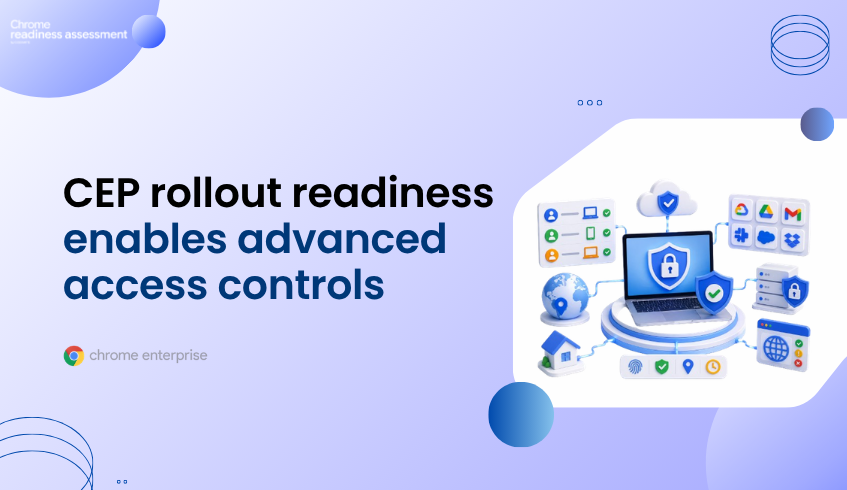
Advanced Access Controls Need CEP Rollout Readiness First
Chrome Enterprise Premium gives organizations a stronger way to secure access in the browser. Its access protection capabilities help teams apply granular controls based on user identity and the context of the request, instead of relying only on broad network or device-based rules.
This matters because modern work access is more distributed. Employees, contractors, partners, and remote users may access SaaS apps, Google Cloud resources, private web apps, and internal systems from different locations and device environments.
Chrome Enterprise Premium supports context-aware access for SaaS, Google Cloud, and private web apps through Chrome. But before organizations can use these advanced controls at scale, they need to deploy CEP successfully across the right users and devices.
That is where Chrome Readiness Assessment helps. CEP Deployment Readiness Insights helps teams understand what could slow or block Chrome Enterprise Premium rollout before deployment begins.
Access Security Needs More Than a Password
A password alone does not give enough context about an access request. A valid user may still be connecting from an unmanaged device, an unusual location, an unsupported browser setup, or a risky environment.
Context-aware access helps organizations make better access decisions by considering more than identity alone. The goal is to understand who is requesting access, what they are trying to access, and whether the request context is acceptable.
This is especially important for organizations that support hybrid work, BYOD users, contractors, partners, and distributed teams. Access can no longer be planned only around the office network.
Chrome Enterprise Premium Supports Smarter Access Rules
Chrome Enterprise Premium access protection is based on Google’s BeyondCorp security model and helps enforce granular access control using the user’s identity and the request context.
This gives IT and security teams more flexibility when protecting web-based work. Instead of treating every request the same way, organizations can build access rules around the conditions that matter.
For example, access decisions can consider context such as user identity, device posture, location, IP address, or other request signals. That creates a stronger access model for SaaS apps, private web apps, and cloud-based resources.
Context-Aware Access Helps Protect SaaS and Web Apps
Many business-critical applications now live in the browser. Users access CRM tools, HR platforms, finance systems, project apps, collaboration tools, and internal portals through web sessions.
Chrome Enterprise Premium secure gateway supports context-aware control over who can access SaaS applications. When users access configured SaaS applications, traffic goes through the secure gateway, which checks whether the user satisfies the access policy.
This helps organizations move toward more precise access control. Access can be managed based on the user and context, not only on whether someone has a login.
Chrome Enterprise Premium also supports secure access for private web applications through the secure gateway, giving teams another path to protect internal web apps without relying only on traditional network access patterns.
Advanced Features Still Need a Ready Environment
Advanced access controls can only deliver value when the rollout is planned well. If devices, browser environments, connectivity, policies, or operational conditions are not ready, deployment can become harder than expected.
This is why readiness matters before teams move deeper into Chrome Enterprise Premium. Access protection is not just a security setting. It depends on the environment where users, devices, browsers, and applications connect.
Before teams expand CEP access controls, they need to understand where rollout gaps may exist. That visibility helps reduce surprises and gives IT teams a better way to plan deployment waves.
CRA Helps Teams Prepare for CEP Access Protection
Chrome Readiness Assessment helps organizations move from interest in Chrome Enterprise Premium to a more practical deployment plan.
CEP Deployment Readiness Insights is designed to help organizations assess whether their devices and environments are ready for Chrome Enterprise Premium rollout. It helps teams identify blockers, prioritize investigation, and plan adoption with more confidence.
This makes the connection clear. If teams want to use advanced Chrome Enterprise Premium features such as context-aware access, they first need to understand whether the environment is ready for CEP deployment.
CRA helps provide that starting point.
From Access Ambition to Deployment Readiness
Chrome Enterprise Premium can help organizations move toward smarter, more context-aware access security. It gives teams a way to protect SaaS apps, private web apps, Google Cloud resources, and browser-based work with more granular control.
But access protection should not begin with assumptions. Before deploying advanced controls, teams need readiness visibility across the environment.
CEP Deployment Readiness Insights helps organizations understand what may need review before rollout begins, making it easier to plan Chrome Enterprise Premium adoption with fewer surprises.
For a deeper look at rollout planning, read CEP Deployment Readiness Insights.
FAQ
What is context-aware access in Chrome Enterprise Premium?
Context-aware access helps organizations control access based on user identity and the context of the request, rather than relying only on login credentials.
What kinds of apps can Chrome Enterprise Premium help secure?
Chrome Enterprise Premium supports access protection for SaaS applications, Google Cloud resources, and private web applications through Chrome.
Why does CEP readiness matter before using advanced access controls?
Advanced access controls depend on a successful CEP rollout. Teams need to understand whether devices, browsers, policies, and environments are ready before expanding those controls.
How does CRA support this planning?
CRA supports planning through CEP Deployment Readiness Insights, which helps teams assess readiness, identify blockers, and plan Chrome Enterprise Premium adoption with more confidence.
Is this the same as DLP or threat protection?
No. DLP focuses on sensitive data movement, and threat protection focuses on phishing, malware, and unsafe sites. Context-aware access focuses on controlling who can access apps and resources based on identity and request context.
Chrome Enterprise Premium gives organizations advanced access protection capabilities. CRA helps teams take the practical first step by checking whether the environment is ready before those controls are deployed at scale.